
What this is about
Now flour, water, levain, and salt become a dough that can hold gas. You don't knead for this; you give the flour time and stretch the dough in the bowl, four times at half-hour intervals.
How to do it
All times belong to the baking day from the chapter before and apply to 24 °C at the dough.
- Saturday at 16:00, mix flour and water: Put 800 g bread flour, 200 g rye flour, and 680 g water in the large bowl; keep the remaining 20 g of water ready for step 3. The water should be lukewarm, around 25 °C. This is the guide value for a kitchen at 22 °C: the dough then ends up at about 24 °C. If your kitchen is warmer, use slightly cooler water; if it is colder, slightly warmer. Mix by hand until no dry flour is visible. Do not knead.
- Rest, 30 minutes: Cover the bowl and let the mass stand. During this time the flour soaks up water on its own. The dough becomes smoother and holds together better, and you need less work afterward.
- 16:30, work in the levain and salt: Place the 200 g levain on the dough as a dollop. Wet one hand, pinch the levain into the dough, and fold the dough over itself in the bowl until the levain is evenly spread and nothing is lumpy. Then sprinkle the 20 g salt on top, add the 20 g of water you held back, and work it in by pinching and folding until it no longer feels gritty. From now on, bulk fermentation is running, the first fermentation of the whole dough.
- Measure the dough temperature: Stick the thermometer into the middle of the dough. The target is 24 °C. Write the value down.
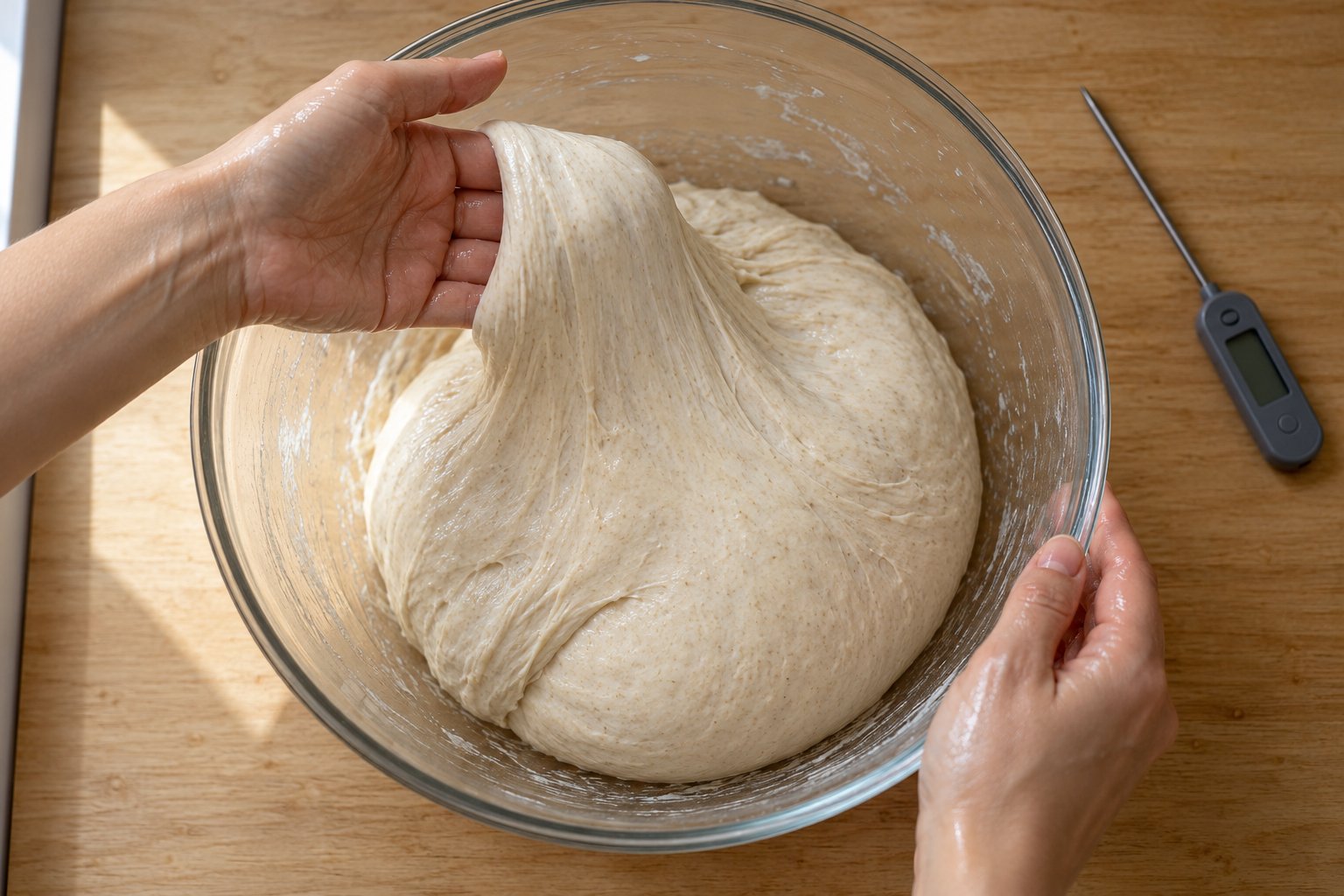
- 17:00, 17:30, 18:00, and 18:30, stretch and fold: Wet your hands. Grab the dough at one edge, pull it up until you feel resistance, and lay it over the middle. Turn the bowl a bit and repeat until you have pulled all four sides. That is one round. Cover the bowl again afterward. Pull only as far as the dough can still be folded; if it tears, wait half an hour. After folding, the dough sits as a bundle in the bowl and spreads out again over the next half hour. That is right.
How you know it is right
After the last round at 18:30, the dough is smooth and elastic. It keeps its shape and feels silky. Then do the windowpane test: tear off a piece the size of a ping-pong ball, press it flat, and let it rest for two minutes. Then slowly pull it apart and hold it up to the light. It should hold and show light and dark spots against the light. That is enough for your bread. If the piece tears right away, wait two minutes and test again; after a short rest, the dough often stretches further.

At 16:30 the dough is at 24 °C if you choose the water as described above. If it is below that, bulk fermentation runs slower: it then takes longer than four hours, and you push the plan back. How you recognize this is in the next chapter.
Rules to remember
- First mix only flour and water and let them rest for 30 minutes; levain and salt come afterward.
- Measure the dough temperature in the middle: 24 °C is the target.
- Stretch and fold with wet hands, four times at half-hour intervals, no more often.
In the Pro edition: kneading by hand and by machine, autolyse and fermentolyse, calculating the dough temperature from the water, coil fold and lamination, and how the gluten network builds.