
What this is about
In this course you bake one bread and follow one plan. Everything else comes later.
The bread
The bread is a wheat-rye loaf with 80 parts wheat and 20 parts rye. These are the ingredients for one large loaf:
- 800 g bread flour (in Germany: Type 1050)
- 200 g medium rye flour (Type 1150)
- 700 g water, of which 20 g held back (step 3)
- 200 g ripe levain
- 20 g salt
That is about 73 % hydration, meaning about 73 percent water on the total flour, the levain included. German bakers call this TA 173: the flour counts as 100, and the water adds 73 to it. The levain is the build made for this one bread: starter that you multiply with fresh flour and water into a pre-ferment. It makes up about one tenth of the total flour. You don't need to calculate anything more: weigh what is listed.
You need a scale accurate to the gram, a thermometer, a large bowl, a banneton, and a pot with a lid that fits in your oven. Keep the levain and the dough in a spot at 24 °C; if your kitchen is cooler, read the paragraph under the plan.
The levain
Here is how to make it:
- Saturday at 8:00: Your starter from the fridge has been refreshed twice and is at its peak. Put 20 g starter in a clean jar with straight walls.
- Flour and water: Add 90 g flour and 90 g water. Take the flour from the same mix as for the bread, most easily 72 g wheat and 18 g rye, or use only bread flour. It comes in addition to the 1000 g of flour in the main dough. Stir until smooth.
- Mark and wait: Put a rubber band at the height of the mixture and rest the lid on loosely. Put the jar in a spot at 24 °C and measure the temperature at the jar. After about 7 to 8 hours the levain is ripe, which is shortly before 16:00. Feed the rest of your starter as in the chapter before and put it back in the fridge; that way it is ready again for the next baking day.
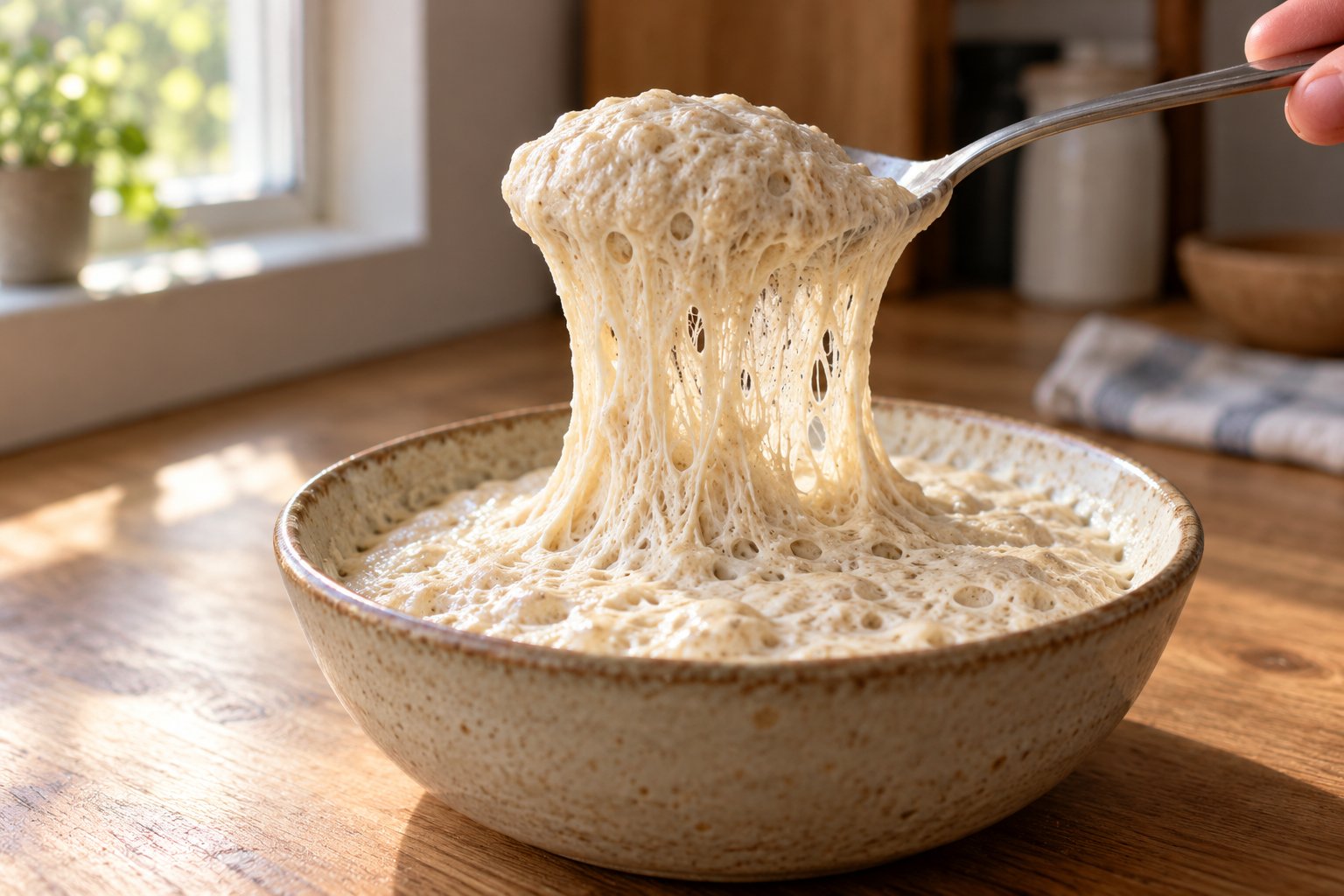
How you know it is ripe
The levain is ripe when the surface domes and bubbles sit throughout the mass, including along the glass wall. It smells sour with a sweetness behind it, similar to yogurt. It stands clearly higher than the rubber band, at least doubled. What matters is the combination of these signs, not the height alone.
If the middle has sunk and streaks remain on the glass wall above the fill level, it is overripe. You can still use it, but your bread will be more sour.
Baking day at a glance
This is how the weekend goes, from refreshing to the first slice. Read the plan through once and hang it in your kitchen; each following chapter explains one part of it. The times apply to 24 °C at the dough.
- Friday 8:00 and 20:00: Refresh the starter
- Saturday 8:00: Start the levain
- Saturday 16:00: Mix flour and water, 30-minute rest
- Saturday 16:30: Work in the levain and salt; bulk fermentation begins, the first fermentation of the whole dough at 24 °C
- Saturday 17:00, 17:30, 18:00, and 18:30: four rounds of stretch and fold
- Saturday 20:30: The dough is done, about one and a half times its volume; preshape
- Saturday 21:00: Shape, put it in the banneton, put it in the fridge at 4 °C
- Sunday 7:00: Preheat the oven with the pot to 250 °C
- Sunday 8:00: Bake, 20 minutes with the lid, then 25 minutes without at 230 °C
- Sunday 9:00: Let it cool, first slice from 11:00
If your room is colder, everything takes longer. The times apply to 24 °C, and you measure the temperature at the dough, not in the kitchen. Below 21 °C the dough needs much longer, and you push the plan back.
Rules to remember
- The plan is for 24 °C: measure the temperature at the dough and at the jar.
- You recognize a ripe levain by dome, bubbles, and smell, not by the clock.
- Weigh every ingredient; one bread, one plan.
In the Pro edition: baker's percentages, the levain builds, how you control sourness with the amount of levain, backward planning for every day of the week, and the plan for people with a job.