
What this is about
A bakery oven makes steam when the loaves go in, and the steam keeps the crust soft at first so the loaf can rise. Your Dutch oven replaces this oven: it traps the steam that the dough gives off itself. Without a pot it does not work as well. So for this chapter you need a cast-iron Dutch oven with a lid, with room for your loaf and a little air around it. The rest is patience while preheating and a sure grip when loading.
How to do it
- Sunday 7:00, preheat: Put the cast-iron Dutch oven with its lid on the rack in the lower half of the oven. Set top and bottom heat to 250 °C and preheat for one hour. The pot needs this time to get hot all the way through. The oven shows its temperature earlier; the pot lags behind.
- 8:00, prepare the dough: Take the banneton straight out of the fridge. Lay a piece of parchment paper on the dough and flip the banneton onto it. The seam, the join from shaping, is now underneath, and the smooth surface is on top.
- Score: Score the surface once with a razor blade or a sharp knife, in one stroke, about one centimeter deep and at a slight angle. The cut gives the loaf the place where it may burst open. A single cut is enough.
- Load it: Put on oven mitts and take off the lid. Set it down where nobody will bump into it. Lift the dough by the paper into the hot pot, put the lid on, and slide the pot straight back into the oven.
- 8:00 to 8:20, lid on: Bake for 20 minutes at 250 °C. During this time the pot holds the steam, and the loaf grows.
- 8:20, lid off: Open the oven, take off the lid with oven mitts, and keep your face to the side, because hot steam rises. The loaf is now pale and glossy. Set the oven to 230 °C.
- 8:20 to 8:45, uncovered: Bake for 25 minutes, until the crust is dark brown. Look in briefly after 15 minutes, because the color comes quickly now.
- 8:45, take it out: Lift the bread out of the pot by the paper and put it on a rack. The pot stays hot; touch it only with oven mitts. Do not leave the bread standing in the pot, because the steam there would soften the crust again. What happens next is in the next chapter.

How you know it is right
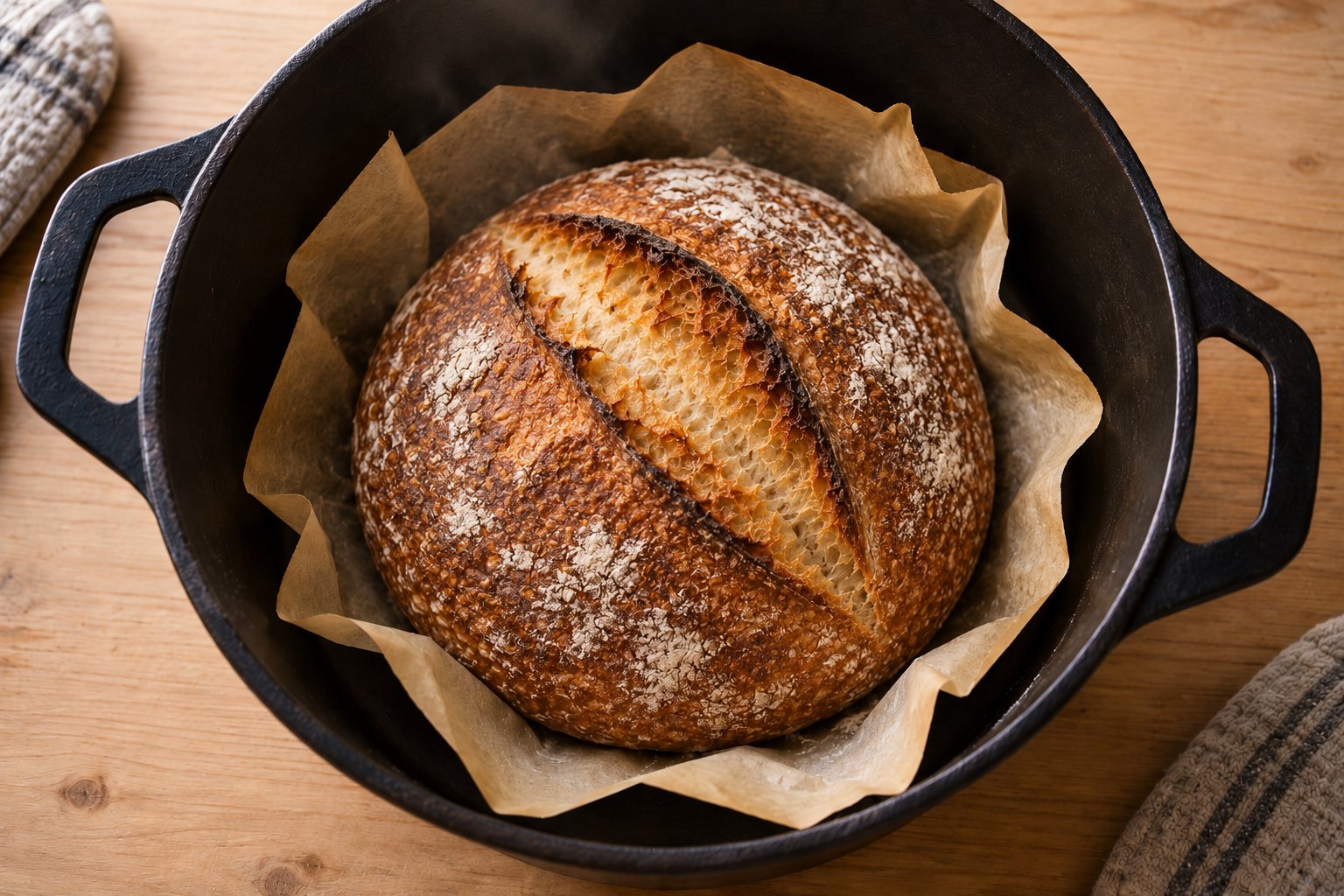
The crust is dark brown, not light brown, and the score has burst open. Tap the bottom of the bread with a knuckle: it sounds hollow. If you have a thermometer, push it in from the bottom into the middle: the internal temperature is then 98 °C. The color decides; the internal temperature confirms. If the crust is still too pale, bake a few minutes longer. If it is darker than you like, lower the temperature earlier next time, right after taking off the lid, not only at the end. A sticky crumb inside means: baked too briefly. The dough goes cold into the hot pot, and that is right: cold, it can be scored more cleanly and keeps its shape until the heat sets it. So do not wait until it reaches room temperature.
Rules to remember
- Preheat the pot for an hour; the oven alone is not hot enough.
- The steam stays in the pot for 20 minutes, then the lid comes off.
- The color decides, not the clock.
In the Pro edition: how oven spring comes about, steam without a pot, baking stone and steel, bake times by weight, controlling the crust, and bake loss.